How Burst-Mode Parameters Affect Material Processing with Femtosecond Lasers
Presented by:
Karolis Keina, Light ConversionScaling femtosecond laser micromachining toward higher throughput while preserving processing quality remains a fundamental challenge. Simply increasing pulse energy does not deliver proportional gains in ablation efficiency due to nonlinear energy deposition, plasma shielding, and heat accumulation. Burst-mode operation, particularly in the MHz and GHz intra-burst regimes, offers an alternative approach to tailor laser–material interaction dynamics to overcome these limitations.
Keina investigates how intra-burst spacing, sub-pulse number, burst envelope shape, and BiBurst configurations influence micromachining performance across a wide range of industrial materials. MHz bursts (~15 ns spacing) enhance metal ablation efficiency by maintaining near-optimal fluence for individual pulses while reducing plasma shielding, enabling higher average power processing without compromising surface quality.
In contrast, GHz bursts (200–400 ps spacing) promote plasma–light coupling and controlled heat accumulation, increasing removal rates in transparent materials and enabling surface remelting for improved finish in metals and polymers. For glass and fused silica, GHz bursts significantly increase specific removal rates and enable high-speed deep drilling, creating nearly taperless holes in sub-millimeter samples and rapid drilling through centimeter-scale thicknesses using long-GHz burst regimes. In silicon, BiBurst processing improves removal rates by up to threefold compared to single-pulse operation.
Tailoring the burst envelope also reveals substantial differences in crater morphology and material removal depth, demonstrating the importance of temporal pulse shaping for material-specific process optimization.
These results demonstrate that material-specific burst optimization enables simultaneous gains in throughput, precision, and processing quality.
About the presenter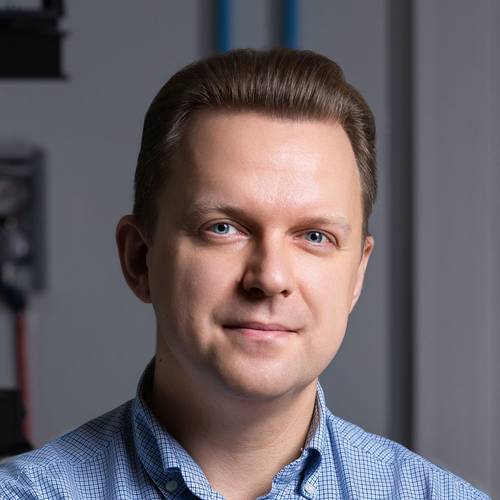
Karolis Keina is the head of industrial sales at Light Conversion, with more than 10 years of experience in the photonics industry.